
Emergency line open 24/7 · Times shown in ET
Indoor air quality and humidity in cooling season
Cooling is a humidity problem as much as a temperature one. A system that lowers the thermometer without removing moisture leaves a house that is cold and clammy, and that is a sizing and runtime issue rather than a filter issue.
Your call connects you with an independent local HVAC provider. No obligation.
Call (855) 321-3194How much does indoor air quality and humidity cost and how fast can I get it?
Indoor air quality work runs a figure the provider confirms on site depending on the equipment fitted. Call (855) 321-3194 and we connect you with an independent local provider who assesses the home and quotes on site before anything is installed.
Signs you need this service
- Air that feels clammy even when cool
- A musty smell when the system starts
- Dust building up quickly after cleaning
- Indoor humidity that stays high
- Allergy symptoms that worsen indoors
- Condensation on supply registers
Signs worth addressing
Comfort complaints that temperature alone does not explain usually come down to humidity, filtration or ventilation. These are the ones that come through this line most.
Oversized cooling causes clammy houses
An air conditioner removes moisture only while it is actually running, and it takes several minutes of runtime before the coil is cold enough to condense much water. A system that is too large for the house satisfies the thermostat in short bursts, shuts off before it has dehumidified anything, and leaves indoor humidity high while the air temperature reads correctly. The result is a house that feels damp and cold at the same time. The fix is rarely a bigger system. It is correct sizing, longer run cycles at lower output, or dedicated dehumidification.
Parts and failure points
| Part | What you notice |
|---|---|
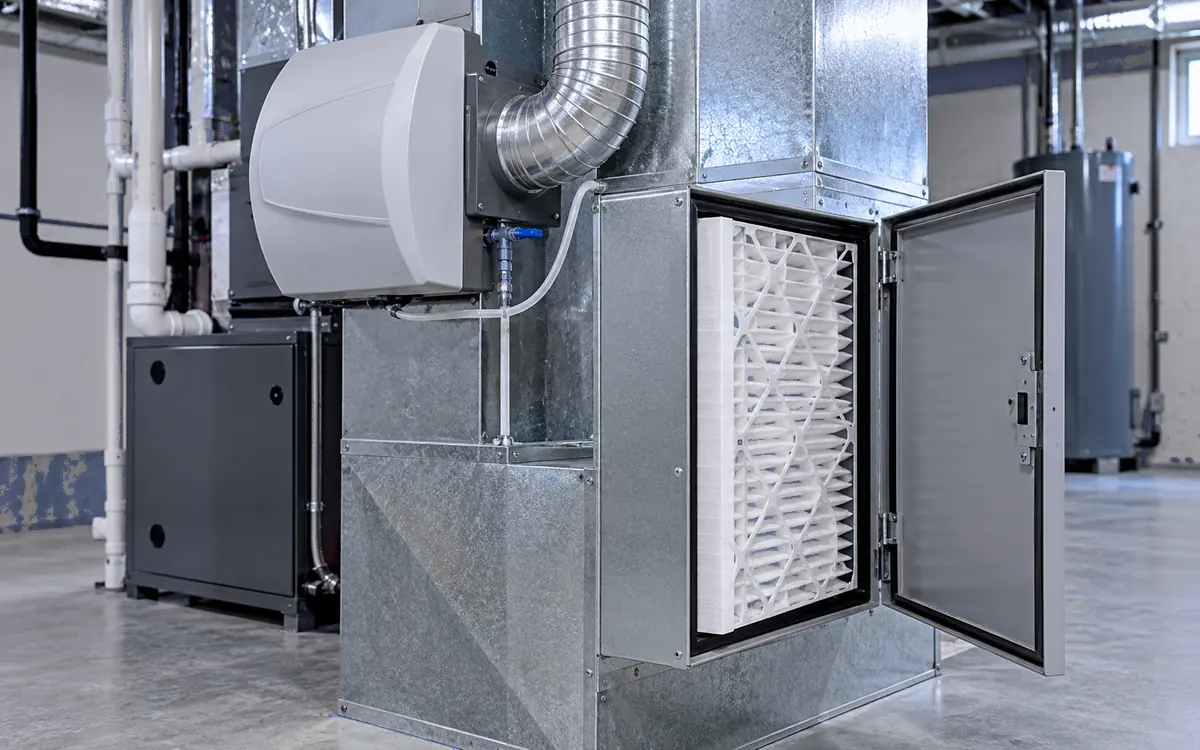
| Media filter cabinet | Dust passing the filter |
| UV lamp | Coil biofilm and musty smell |
| Humidifier | Dry air, static shocks |
| Dehumidifier | Clammy air, high indoor humidity |
| Ventilator | Stale air in a tight home |
| Duct seal | Dust drawn in from unconditioned space |
What the visit looks like
- Home assessment
Humidity levels, existing filtration and any known air quality concerns noted before equipment is specified.
- Equipment selection
Dehumidifier, air purifier or filtration upgrade matched to the load and the duct system.
- Installation
Equipment installed in the air handler or ductwork. Electrical and drain connections confirmed.
- Air quality test and sign-off
Humidity and airflow verified after installation. The provider explains what the equipment does and how to maintain it.
Repair or replace
Cooling systems degrade gradually and the decision turns on refrigerant circuit integrity as much as age. A unit that has lost refrigerant twice in four years has a slow leak somewhere in the system; the next recharge is not a fix. A compressor failure on a unit older than 12 years almost always tips the math toward replacement, because the compressor is the highest-cost component and the rest of the system has already depreciated past its midpoint.
Efficiency is the third factor. A 10-SEER unit from the mid-2000s running against a 90°F summer uses roughly twice the electricity of a current mid-grade replacement. ENERGY STAR heating and cooling publishes rated efficiency tiers so you can put a real number to the gap.
| Unit age | Minor fault | Major component |
|---|---|---|
| Under 8 years | Repair | Repair, verify warranty coverage |
| 8 to 13 years | Repair | Get a replacement quote alongside the repair |
| 14 years or more | Repair as a bridge only | Replace: compressor cost exceeds system value |
Safety panel
- Gas smell: leave the building, then call the gas utility or 911 from outside. Do not operate switches on your way out.
- Carbon monoxide alarm sounding: leave the building and call 911. Do not go back in to investigate.
- Electrical burning smell: shut off the breaker feeding the air handler and the condenser, then call.
- Refrigerant: handled only by technicians holding EPA Section 608 certification. Never vent or top up a system yourself.
Providers in this network work on equipment from Carrier, Trane, Lennox, Goodman, Rheem, York, American Standard, Bryant, Amana, Daikin, Mitsubishi Electric, Ruud. HVAC Emergency USA is an independent referral service and is not affiliated with, endorsed by or authorised by any equipment manufacturer.
The other angle
The same service written for heating season: Indoor Air Quality and Humidity, heating vertical.
Coverage
Find this service in your city
By state
Other cooling services
- AC Repair
- AC Installation and Replacement
- Furnace Repair
- Furnace Installation and Replacement
- Heat Pump Repair
- HVAC Maintenance and Tune-Up
- Duct Cleaning and Sealing
- Thermostat Installation and Repair
- Boiler Repair
Related guides
Questions
Indoor Air Quality and Humidity questions
How much does indoor air quality and humidity cost?
Typical completed jobs run a figure the provider confirms on site including parts and labor. A diagnostic visit is usually a figure the provider states up front. The provider confirms the exact figure on site before any work begins, and you approve it first.
How quickly can a provider attend?
The line is answered 24/7 in ET. Actual attendance depends on provider participation, your location, technician availability and demand that day. The operator tells you the window on offer rather than booking one nobody can meet.
Do you carry out the work yourselves?
No. HVAC Emergency USA is a referral service. We do not own trucks or employ technicians. We connect you with an independent local provider, and verifying their licence and insurance before work starts is your responsibility.
Do I have to be home for the visit?
Yes. The technician needs access to the thermostat, the indoor air handler and the outdoor unit, and someone has to approve the quoted price before any work begins. That approval cannot be given remotely.
Is topping up refrigerant a repair?
Not on its own. A sealed system does not consume refrigerant, so low charge means there is a leak. Adding refrigerant without finding the leak buys a few weeks and means paying for the same gas again.
What if the system is under warranty?
Many manufacturers cover parts for five to ten years, labor rarely. Have the model and serial number ready when you call. The provider can usually tell you whether the part is covered before fitting it.
How do you choose the provider?
By ZIP code first, then by who is accepting calls at that moment. We publish no ratings and sell no placement in a results list. If the provider offered does not suit you, you are welcome to decline.
Is there any charge for calling?
No. There is no charge to call and no obligation to proceed. We may be compensated by providers or partners when you call, which does not change what you are quoted or what you pay.
Written and fact-checked by the HVAC Emergency USA editorial team. Last updated . Editorial policy.