Emergency line open 24/7 · Times shown in ET
Furnace repair, routed to a local provider
No heat with outdoor temperatures below freezing is not a comfort problem. A house loses heat faster than most people expect, and pipework in unconditioned space is at risk within hours.
Your call connects you with an independent local HVAC provider. No obligation.
Call (855) 321-3194How much does furnace repair cost and how fast can I get it?
Call (855) 321-3194 with your ZIP code and we connect you with an independent local provider who confirms the price on site.
Signs you need this service
- No heat at all with the thermostat calling
- Cold air from the vents while the blower runs
- Lockout after three failed ignition attempts
- A burning or electrical smell when it runs
- A yellow, lifting or unstable burner flame
- A loud bang when the burner finally lights
Signs you need furnace repair
Heating faults are more legible than cooling faults, because a furnace tells you what it is doing. Counting the ignition attempts before a lockout, or noticing whether the blower runs at all, narrows the diagnosis considerably before anyone arrives.
What the lockout sequence means
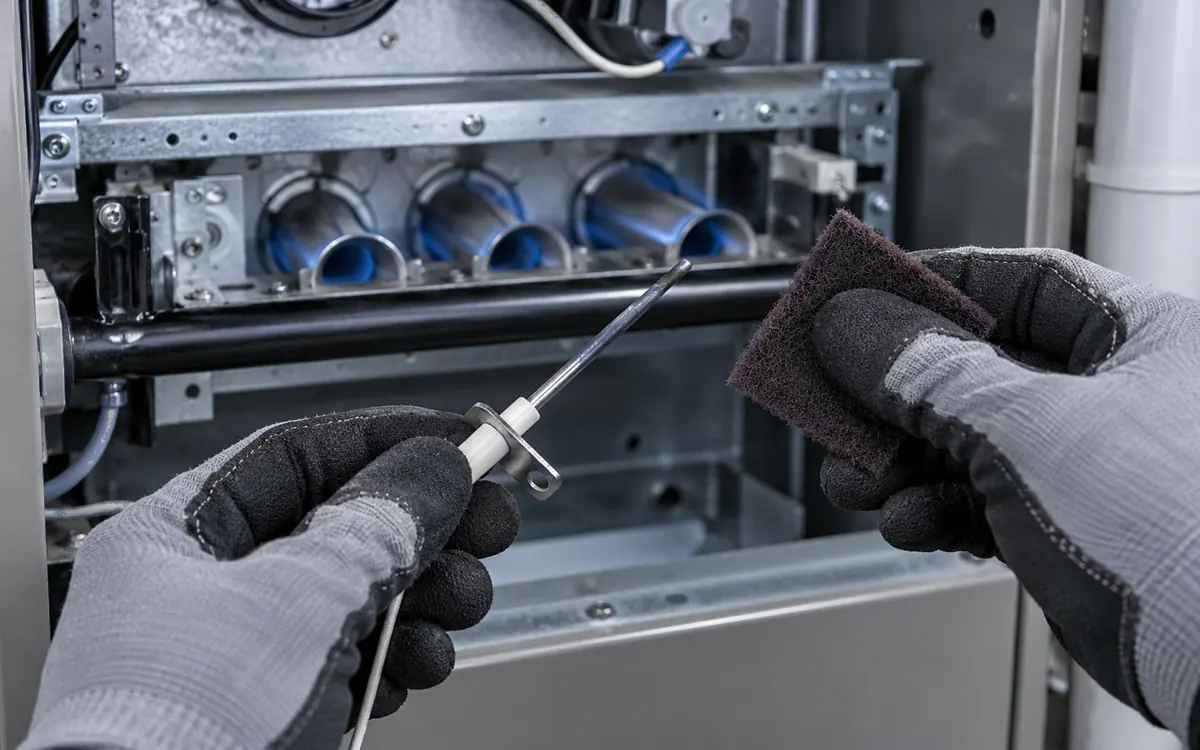
A modern furnace runs a fixed start sequence: the inducer draws, the pressure switch confirms draft, the igniter heats, the gas valve opens, and the flame sensor confirms a flame within a few seconds. If any step fails the board retries, usually three times, then locks out and often flashes a code. That sequence is diagnostic. A furnace that locks out without the inducer running has a different fault from one that lights and drops out, and telling the provider which you observed saves a visit charge worth of time.
Parts and failure points
| Part | What you notice |
|---|---|
| Igniter | No ignition, three tries then lockout |
| Flame sensor | Lights then drops out seconds later |
| Limit switch | Shuts down on overheat |
| Inducer motor | Noisy or no draft before ignition |
| Gas valve | No gas delivery to the burner |
| Control board | Error codes, no sequence |
What the visit looks like
- Symptom check
The technician confirms the fault and asks what the system did before it stopped.
- Sequence and safety test
Ignition sequence, draft, flame signal and any error code at the control board.
- Combustion and airflow
Heat exchanger inspection, flue check and static pressure across the system.
- Quote and approval
The provider quotes before fitting anything, and you approve the figure first.
Repair or replace
Heating system decisions hinge on two risks that cooling systems don't share: a cracked heat exchanger and carbon-monoxide exposure. A confirmed crack is a replacement call regardless of system age, because patching a heat exchanger is not a code-accepted repair. Outside that scenario, age and the cost of the failed part guide the call the same way they do for cooling equipment.
Fuel costs also matter here. An older 80-AFUE furnace running against current gas rates may cost 20–25% more to operate than a 95-AFUE condensing unit. DOE Energy Saver heating and cooling covers efficiency ratings and seasonal operating cost comparisons if you want a baseline.
| Unit age | Minor fault | Major component or cracked exchanger |
|---|---|---|
| Under 10 years | Repair | Repair; verify heat exchanger integrity first |
| 10 to 16 years | Repair | Get a replacement quote; cracked exchanger = replace |
| 17 years or more | Repair as a bridge only | Replace: fuel savings offset replacement cost |
Safety panel
- Gas smell: leave the building, then call the gas utility or 911 from outside. Do not operate switches on your way out.
- Carbon monoxide alarm sounding: leave the building and call 911. Do not go back in to investigate.
- Electrical burning smell: shut off the breaker feeding the air handler and the condenser, then call.
- Refrigerant: handled only by technicians holding EPA Section 608 certification. Never vent or top up a system yourself.
Providers in this network work on equipment from Carrier, Trane, Lennox, Goodman, Rheem, York, American Standard, Bryant, Amana, Daikin, Mitsubishi Electric, Ruud. HVAC Emergency USA is an independent referral service and is not affiliated with, endorsed by or authorised by any equipment manufacturer.
The other angle
The same service written for cooling season: Furnace Repair, cooling vertical.
Coverage
Find this service in your city
By state
Other heating services
- AC Repair
- AC Installation and Replacement
- Furnace Installation and Replacement
- Heat Pump Repair
- HVAC Maintenance and Tune-Up
- Duct Cleaning and Sealing
- Thermostat Installation and Repair
- Boiler Repair
- Indoor Air Quality and Humidity
Related guides
Questions
Furnace Repair questions
How much does furnace repair cost?
Typical completed jobs run a figure the provider confirms on site including parts and labor. A diagnostic visit is usually a figure the provider states up front. The provider confirms the exact figure on site before any work begins, and you approve it first.
How quickly can a provider attend?
The line is answered 24/7 in ET. Actual attendance depends on provider participation, your location, technician availability and demand that day. The operator tells you the window on offer rather than booking one nobody can meet.
Do you carry out the work yourselves?
No. HVAC Emergency USA is a referral service. We do not own trucks or employ technicians. We connect you with an independent local provider, and verifying their licence and insurance before work starts is your responsibility.
Do I have to be home for the visit?
Yes. The technician needs access to the thermostat and the equipment itself, and someone has to approve the quoted price before work begins. For combustion appliances they may also want to check alarms.
What should I do if I smell gas?
Leave the building first, then call the gas utility or 911 from outside. Do not operate light switches, thermostats or phones on your way out. Call us afterwards, once the property has been made safe.
What if the system is under warranty?
Parts warranties of five to ten years are common, labor warranties are not. Have the model and serial number ready so the provider can check coverage before fitting anything.
How do you choose the provider?
By ZIP code first, then by who is accepting calls. We publish no ratings and sell no placement. During a cold snap the set of available providers in a market narrows considerably.
Is there any charge for calling?
No. There is no charge to call and no obligation to proceed. We may be compensated by providers or partners when you call, which does not change what you are quoted or what you pay.
Written and fact-checked by the HVAC Emergency USA editorial team. Last updated . Editorial policy.