
Emergency line open 24/7 · Times shown in ET
Low refrigerant signs: how to tell and what it means
A sealed cooling system does not consume refrigerant. If the charge is low there is a leak, and that single fact should shape every conversation you have about it.
Your call connects you with an independent local HVAC provider. No obligation.
Call (855) 321-3194Is this an emergency or can it wait?
Low charge shows up as gradually weakening cooling, longer run times, ice on the line set and sometimes hissing. It always means a leak, because a sealed system does not consume refrigerant. Call (855) 321-3194 for a local provider.
What you are seeing
Performance signs
- Cooling that weakened gradually over weeks
- Longer run times for the same setpoint
- Ice on the suction line or indoor coil
- Supply air not as cold as it used to be
Leak evidence
- Hissing or bubbling near the indoor coil
- Oily residue at a refrigerant joint
- The system was topped up in a previous season
- Higher electricity bills with the same usage
Do and do not
| Do | Do not |
|---|---|
| Ask for superheat and subcooling readings | Accept a gas top-up with no leak search |
| Ask where the leak was found | Assume refrigerant is consumed over time |
| Shut the system off if the coil has iced | Keep running an iced system |
| Request the charge be weighed in | Let anyone guess the charge by pressure alone |
| Keep records of any previous top-ups | Buy a DIY refrigerant top-up kit |
What causes it, ranked by how often
- Formicary corrosion in the coil. Microscopic pinholes that develop in copper evaporator tubing over years. A common and genuinely difficult leak to locate.
- Vibration fatigue at joints. Years of compressor vibration work on brazed joints and flare connections until one begins to weep.
- Damaged line set. Physical damage to the refrigerant lines, often from garden tools, settlement or rodents.
- Failed Schrader valve. The service port valve core leaking slowly, which is cheap to fix once identified.
- Poor installation braze. A joint made badly at installation that leaks slowly from the beginning.
- Coil corrosion from coastal air. Salt accelerates corrosion on outdoor coils and shortens the time to the first leak.
How a technician diagnoses it
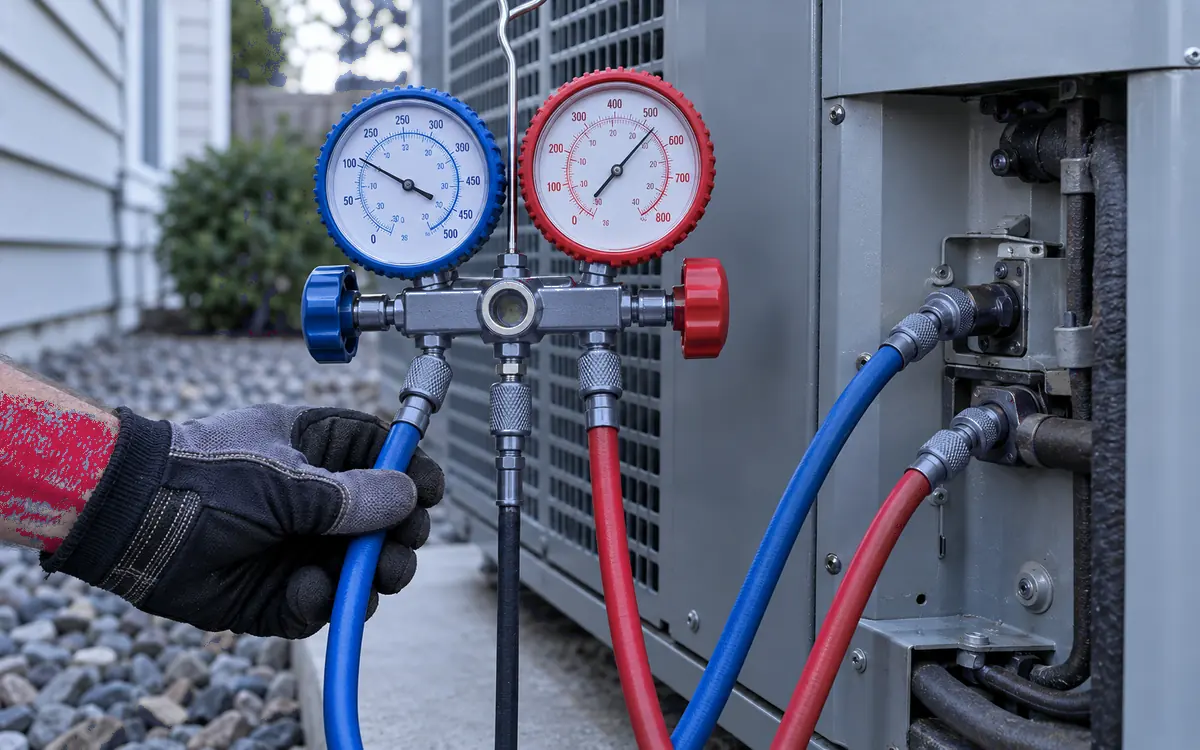
- Measure superheat and subcooling
These two readings together establish whether charge is genuinely low rather than inferred from pressure alone.
- Search for the leak
Electronic detector, soap solution or UV dye depending on the suspected location.
- Repair rather than refill
The leak gets fixed, the system is evacuated, then the charge is weighed in to the nameplate value.
- Verify after repair
A pressure or vacuum test confirms the repair held before refrigerant goes back in.
When to shut the system off
- Ice has formed on the coil or line set.
- The compressor is running hot or struggling.
- You hear hissing near the indoor unit, which may indicate a substantial leak.
- The system has been topped up more than once and is low again.
Quick read
| Urgency | Call today |
|---|---|
| Most likely | Formicary corrosion in the coil |
| Side | Cooling |
Service pages
Related guides
Safety first
Call now, or call the utility first?
Call now
- No cool air during a heat advisory
- No heat with outdoor temperatures below freezing
- Burning smell from the vents
- Water pooling at the air handler
- Ice on the line set
- Breaker tripping on every cycle
Call (855) 321-3194 and give your ZIP code.
Shut it off and call the utility or 911 first
- You smell gas: leave the building, then call the gas utility or 911
- Smoke or sparking at the equipment
- A carbon monoxide alarm is sounding: leave and call 911
Reference: CPSC recalls and US Fire Administration heating fire safety.
Questions
Low refrigerant signs questions
Does an air conditioner use up refrigerant?
No. A correctly sealed system holds its charge for its entire service life. If the charge is low, refrigerant has escaped through a leak, and the leak is the actual fault that needs repairing.
Why not just top it up each year?
Because you pay for the same gas repeatedly while the leak gets worse, and running low on charge stresses the compressor. Some refrigerants are also expensive and increasingly scarce, which makes repeat top-ups poor value.
How do technicians find a leak?
Electronic detectors, soap solution at joints, or UV dye circulated through the system and inspected with a lamp. Which method suits depends on where the leak is suspected and how fast it is losing charge.
Is low refrigerant dangerous?
Not to people in a residential system, but it is damaging to the equipment. Low charge causes the coil to ice and can allow liquid refrigerant to return to the compressor, which destroys it.
Can I add refrigerant myself?
No. Refrigerant handling is restricted to technicians holding EPA Section 608 certification, and venting it is illegal. DIY top-up kits also make it easy to overcharge, which causes its own damage.
What does leak repair cost?
A leak search runs a figure the provider confirms on site. A Schrader valve is cheap at a figure the provider confirms on site a line set repair a figure the provider confirms on site and an evaporator coil replacement a figure the provider confirms on site. Full repair and recharge typically lands a figure the provider confirms on site.
Written and fact-checked by the HVAC Emergency USA editorial team. Last updated . Editorial policy.