
Emergency line open 24/7 · Times shown in ET
Frozen AC coil: why ice forms and what to do
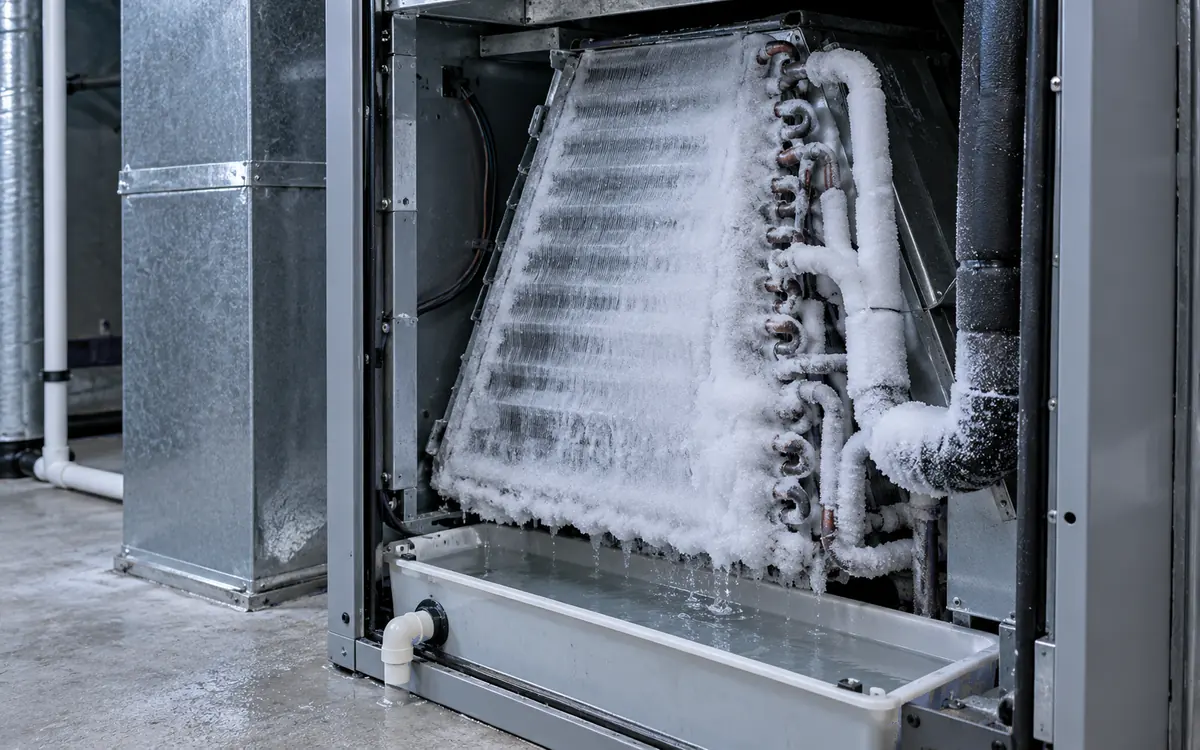
Ice on an air conditioner looks like the system working too hard. It is the opposite: a coil freezes when it cannot absorb enough heat, and running it frozen risks the compressor.
Your call connects you with an independent local HVAC provider. No obligation.
Call (855) 321-3194Is this an emergency or can it wait?
Switch the system off immediately and let the ice thaw completely, which takes several hours. Running a frozen system risks liquid refrigerant reaching the compressor. Then call (855) 321-3194 and we connect you with a local provider.
What you are seeing
Ice symptoms
- Visible ice on the indoor evaporator coil
- Frost or ice along the refrigerant line set
- Ice on the outdoor unit in cooling mode
- Water everywhere once the ice begins melting
What preceded it
- Airflow dropped off before the ice appeared
- The filter is heavily loaded
- Cooling faded gradually over weeks
- Supply registers barely moving air
Do and do not
| Do | Do not |
|---|---|
| Switch the system off and let it thaw fully | Chip, scrape or hammer at the ice |
| Run the fan only, to speed thawing | Restart cooling while any ice remains |
| Replace a loaded filter once thawed | Point a heat gun or hair dryer at the coil |
| Put towels down for the meltwater | Assume it will be fine once it melts |
| Ask for a leak search if charge is low | Accept a refrigerant top-up with no leak search |
What causes it, ranked by how often
- Restricted airflow. The dominant cause. A loaded filter, a dirty coil or a failing blower means too little warm air crosses the coil, its temperature drops below freezing, and condensate turns to ice.
- Low refrigerant charge. Low charge drops the pressure in the evaporator, which drops its temperature below freezing even with adequate airflow. Always means a leak.
- Failing blower motor. A blower turning slowly or not at all starves the coil of air with exactly the same result as a blocked filter.
- Closed or blocked registers. Too many closed supply registers reduces total airflow enough to ice the coil in some systems.
- Dirty evaporator coil. A coil caked with dust is both an airflow restriction and a poor heat exchanger, which compounds the problem.
- Running in cool weather. Operating cooling when outdoor temperature is low drops suction pressure far enough to freeze the coil.
How a technician diagnoses it
- Confirm the system is fully thawed
Nothing useful can be measured on a frozen system, so this comes first.
- Measure airflow
Static pressure, filter condition, blower speed and coil cleanliness.
- Check the charge properly
Superheat and subcooling readings, plus a leak search if the charge is genuinely low.
- Inspect the blower
Wheel cleanliness, motor condition and speed tap, since a slow blower mimics a blocked filter.
When to shut the system off
- Any visible ice on the coil or line set. Shut it off before anything else.
- Water reaching electrical components as the ice melts.
- The breaker trips while the system is iced.
- Ice that reforms within an hour of restarting.
Service pages
Related guides
Safety first
Call now, or call the utility first?
Call now
- No cool air during a heat advisory
- No heat with outdoor temperatures below freezing
- Burning smell from the vents
- Water pooling at the air handler
- Ice on the line set
- Breaker tripping on every cycle
Call (855) 321-3194 and give your ZIP code.
Shut it off and call the utility or 911 first
- You smell gas: leave the building, then call the gas utility or 911
- Smoke or sparking at the equipment
- A carbon monoxide alarm is sounding: leave and call 911
Reference: CPSC recalls and US Fire Administration heating fire safety.
Questions
Frozen AC coil questions
Why is my AC frozen in summer?
A coil freezes when it cannot absorb enough heat from the air crossing it. That means either too little airflow, from a blocked filter or failing blower, or refrigerant pressure that is too low because of a leak.
How long does it take to thaw?
Several hours with the system off, and faster if you run the fan only, which moves room-temperature air across the coil. Do not try to speed it with heat or by breaking the ice away.
Can I just run it again after it melts?
Only briefly, and only to confirm. If the underlying cause has not been corrected it will ice again within hours, and each freeze cycle risks liquid refrigerant returning to the compressor.
Does a frozen coil mean low refrigerant?
Sometimes, but restricted airflow is more common. The two produce identical symptoms from outside, which is why a technician measures static pressure and superheat rather than guessing.
Is a frozen coil dangerous?
Not to people, but it is genuinely dangerous to the compressor. Liquid refrigerant does not compress, and a compressor asked to handle it can be destroyed in a single cycle.
What will this cost?
If it is airflow, a figure the provider confirms on site for filter and airflow correction or a figure the provider confirms on site for a coil clean. If it is a refrigerant leak, a figure the provider confirms on site. A failing blower motor runs a figure the provider confirms on site.
Written and fact-checked by the HVAC Emergency USA editorial team. Last updated . Editorial policy.