
Emergency line open 24/7 · Times shown in ET
AC leaking water: causes, fixes and what it costs
A cooling coil pulls moisture out of the air continuously, and all of it has to go somewhere. Water appearing where it should not is nearly always the drain rather than the refrigerant circuit.
Your call connects you with an independent local HVAC provider. No obligation.
Call (855) 321-3194Is this an emergency or can it wait?
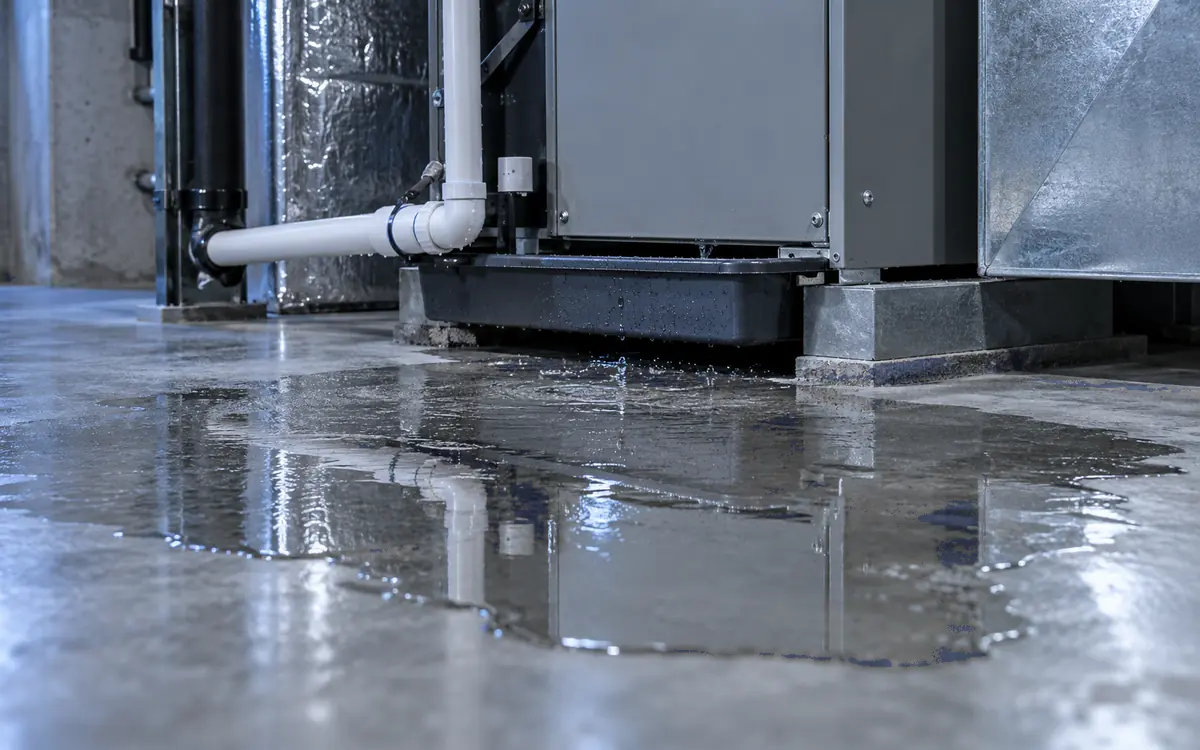
Water at the air handler is almost always a blocked condensate drain rather than a refrigerant leak. Switch the system off to stop more water forming, then call (855) 321-3194 and we connect you with a local provider.
What you are seeing
Drainage symptoms
- Water pooling at the base of the air handler
- A damp patch on the ceiling below an attic unit
- The overflow switch has shut the system off
- Water staining around the drain line
Secondary causes
- Ice on the coil that melts into the pan
- A rusted or cracked drain pan
- A drain line that has come loose
- Gurgling from the drain during operation
Do and do not
| Do | Do not |
|---|---|
| Switch the system off to stop more condensate forming | Keep running it and mop up repeatedly |
| Clear standing water away from electrical components | Ignore water near the control board |
| Check whether the filter is loaded, which causes icing | Pour chemicals down the drain line |
| Let any ice thaw completely before restarting | Restart the system while the coil is still iced |
| Note whether the water appears only while running | Assume it is a refrigerant leak |
What causes it, ranked by how often
- Blocked condensate drain. By far the most common. The line is dark, damp and slightly warm, which suits biological growth. Once it blocks, the pan fills and overflows.
- Frozen evaporator coil. Ice forms on the coil, then melts faster than the pan can drain. Usually caused by restricted airflow or low refrigerant charge.
- Overflow switch tripped. Not a leak at all but the designed response: a float detects a full pan and shuts the system off before water escapes.
- Cracked or rusted drain pan. Older units develop pan corrosion, and water escapes before it ever reaches the drain.
- Disconnected drain line. A line that has come apart at a joint dumps condensate directly into the cabinet or onto the floor.
- Poor installation slope. A drain line without a consistent fall never empties properly and holds water that eventually backs up.
How a technician diagnoses it
- Confirm the water appears only during cooling
Condensate forms only while the coil is cold, which separates it from a plumbing leak.
- Inspect the pan and the drain
Standing water in the pan with a dry line downstream confirms a blockage.
- Clear and flush the line
Vacuum or compressed air through the cleanout, then verify flow from the termination point.
- Check for icing causes
Filter condition, airflow and refrigerant charge, since a frozen coil produces more water than the pan is designed for.
When to shut the system off
- Water is pooling near electrical components or the control board.
- Water is staining a ceiling below an attic air handler.
- Ice is visible on the coil or line set.
- The overflow switch keeps tripping after being reset.
Service pages
Related guides
Safety first
Call now, or call the utility first?
Call now
- No cool air during a heat advisory
- No heat with outdoor temperatures below freezing
- Burning smell from the vents
- Water pooling at the air handler
- Ice on the line set
- Breaker tripping on every cycle
Call (855) 321-3194 and give your ZIP code.
Shut it off and call the utility or 911 first
- You smell gas: leave the building, then call the gas utility or 911
- Smoke or sparking at the equipment
- A carbon monoxide alarm is sounding: leave and call 911
Reference: CPSC recalls and US Fire Administration heating fire safety.
Questions
AC leaking water questions
Why is my AC leaking water inside?
Almost always a blocked condensate drain. The coil removes moisture from the air continuously and it runs to a pan and out through a line. When that line blocks, the pan overflows into the cabinet or onto the floor.
Is a leaking AC an emergency?
It becomes urgent when water is near electrical components or soaking into a ceiling below an attic unit. Switching the system off stops more condensate forming, which is usually enough to hold the situation until a provider arrives.
Can I clear the drain myself?
A wet vacuum at the outdoor termination clears some blockages. Avoid pouring bleach or chemicals into the line, which can damage the pan and fittings. If it blocks repeatedly, something upstream needs attention.
Why did my AC shut itself off?
Many systems have a float switch that detects a full drain pan and cuts the system off before water escapes. That is the safety working as intended, not a separate fault.
Does leaking water mean low refrigerant?
Not directly, but low charge can cause the coil to ice, and melting ice produces more water than the pan handles. If the coil is icing, the charge and the airflow both need checking.
How much does this cost to fix?
Clearing a drain line typically runs a figure the provider confirms on site. An overflow switch is a figure the provider confirms on site and a replacement drain pan a figure the provider confirms on site. The provider confirms the price before starting.
Written and fact-checked by the HVAC Emergency USA editorial team. Last updated . Editorial policy.