
Emergency line open 24/7 · Times shown in ET
Thermostat not working: causes, fixes and what it costs
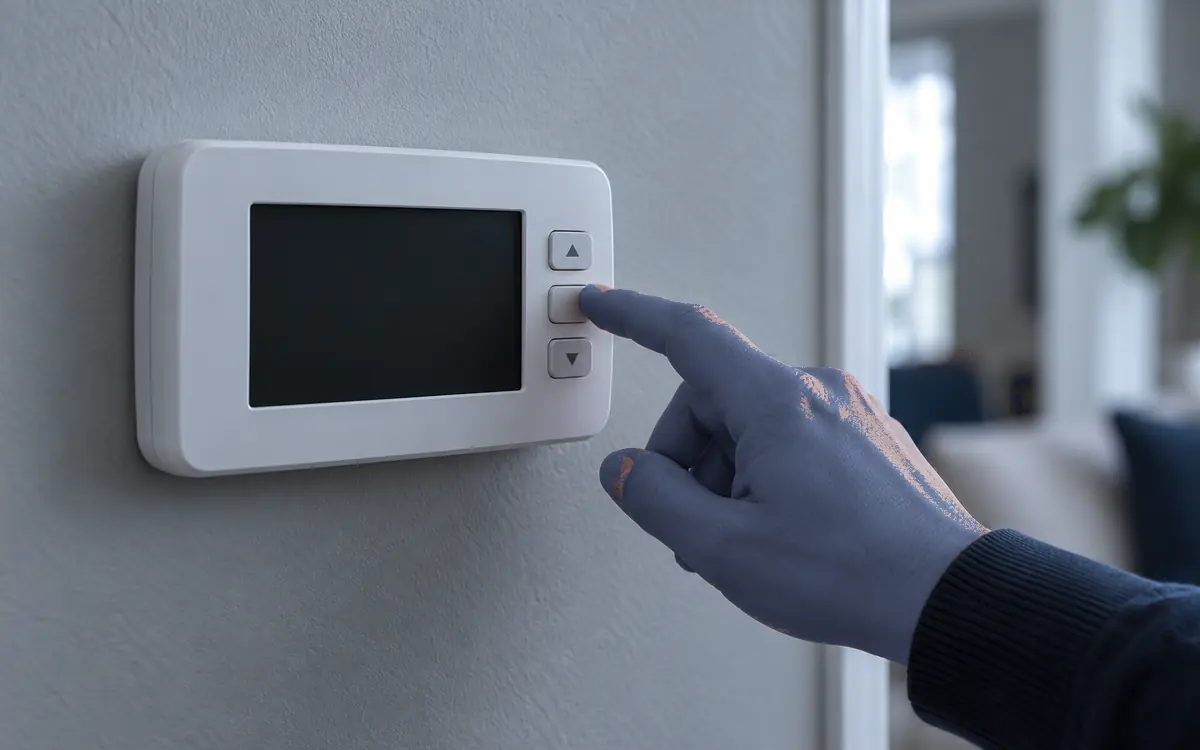
A thermostat fault looks exactly like an equipment fault from inside the house, because the equipment is never asked to run. It is also the quickest and least costly thing to rule out, which is why technicians check it first.
Your call connects you with an independent local HVAC provider. No obligation.
Call (855) 321-3194Is this an emergency or can it wait?
Check the batteries, the breaker and whether the display responds at all. A blank or unresponsive thermostat often has a power problem rather than a broken control. Call (855) 321-3194 and we connect you with a local provider.
What you are seeing
Control symptoms
- The display is blank or drops out
- The reading does not match a separate thermometer
- The system will not switch between heating and cooling
- Settings change but nothing happens
Underlying causes
- The furnace or air handler is completely silent
- A low-voltage fuse on the control board has blown
- The thermostat was recently replaced
- No C-wire is present at the thermostat
Do and do not
| Do | Do not |
|---|---|
| Replace the batteries if the model takes them | Assume a blank screen means a broken thermostat |
| Check the breaker and the equipment service switch | Rewire a thermostat without photographing the terminals first |
| Compare the reading against a separate thermometer | Mount a thermostat on an exterior wall or in direct sun |
| Photograph the wiring before removing anything | Force a conventional control onto a heat pump |
| Note whether heating, cooling or both are affected | Keep cycling modes rapidly to test it |
What causes it, ranked by how often
- Dead batteries or lost power. The simplest and most common. A blank display on a battery model, or a tripped breaker on a hardwired one.
- Blown low-voltage fuse. Most control boards carry a small fuse protecting the 24 volt circuit. A shorted thermostat wire blows it and the thermostat goes dark.
- Missing C-wire. Modern controls need continuous power from a common conductor. Many older homes have no C-wire run, so a new thermostat behaves erratically or dies.
- Poor placement. A thermostat in direct sun, above a lamp or on an exterior wall reads a temperature the rest of the house is not experiencing.
- Wiring fault. A break, a loose terminal or corrosion in the run between the thermostat and the equipment.
- Wrong control for the equipment. A conventional thermostat fitted to a heat pump cannot manage the reversing valve or stage auxiliary heat correctly.
How a technician diagnoses it
- Confirm power at the thermostat
Batteries, breaker, service switch and the board fuse, in that order.
- Check the wiring and terminals
Loose, corroded or incorrectly landed conductors account for a large share of these calls.
- Test the equipment directly
Jumpering the call at the board proves whether the fault is the control or the equipment behind it.
- Verify the control suits the system
Particularly on heat pumps, where the wrong control produces expensive behaviour rather than obvious failure.
When to shut the system off
- The thermostat is hot to the touch or smells of burning.
- A blown fuse keeps recurring immediately after replacement.
- Bare conductors are visible at the sub-base.
- The system runs continuously and will not respond to any setting.
Quick read
| Urgency | Call today |
|---|---|
| Most likely | Dead batteries or lost power |
| Side | Cooling and heating |
Safety first
Call now, or call the utility first?
Call now
- No cool air during a heat advisory
- No heat with outdoor temperatures below freezing
- Burning smell from the vents
- Water pooling at the air handler
- Ice on the line set
- Breaker tripping on every cycle
Call (855) 321-3194 and give your ZIP code.
Shut it off and call the utility or 911 first
- You smell gas: leave the building, then call the gas utility or 911
- Smoke or sparking at the equipment
- A carbon monoxide alarm is sounding: leave and call 911
Reference: CPSC recalls and US Fire Administration heating fire safety.
Questions
Thermostat not working questions
Why is my thermostat screen blank?
Dead batteries on a battery-powered model, or a power problem on a hardwired one. That usually means a tripped breaker, a knocked-off equipment service switch, or a blown low-voltage fuse on the control board.
What is a C-wire and do I need one?
The C-wire is a common conductor that supplies continuous power to the thermostat. Modern controls with screens and connectivity need it. Many older homes do not have one, which is the usual reason a thermostat upgrade costs more than the device.
Why does my thermostat read the wrong temperature?
Placement is the usual culprit. Direct sun, a nearby lamp, a draughty exterior wall or a supply register blowing across it all make the thermostat read something the rest of the house is not experiencing.
Can a bad thermostat stop my whole system?
Yes. If the control never closes the circuit, the equipment is never asked to run and looks completely dead. That is why a technician tests the call at the board before condemning anything expensive.
Do heat pumps need a special thermostat?
Yes. A heat pump control manages the reversing valve and stages auxiliary heat. Fitting a conventional thermostat to a heat pump typically leaves it running expensive resistance heat or failing to switch modes.
How much does a thermostat replacement cost?
Typically a figure the provider confirms on site fitted, depending on the control and whether wiring work is needed. Adding a C-wire where none exists adds a figure the provider confirms on site on top.
Written and fact-checked by the HVAC Emergency USA editorial team. Last updated . Editorial policy.